Showing posts with label Legends of music. Show all posts

Tuesday, April 10, 2012

The Pogues: live in Melbourne, 2012 (review)

Venue: Festival Hall
Date: 04/04


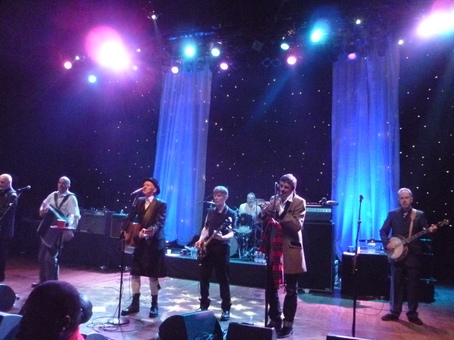
If there’s one holiday Australian’s truly get behind with gusto, it’s the celebration of St Patrick’s Day, and so having Celtic punk legends The Pogues in town was excuse enough for a mini-reprise of the festivities. Oversized green leprechaun hats, Irish sport shirts, endless shamrocks and the guff of whiskey breath fills Festival hall, along with the general rowdiness of your local watering hole near closing time.

 
Being a Pogues gig – their first in Australia for 22 years – mass alcohol consumption is a given. The only question yet to be answered is who will be the most pissed; the fans or the band’s renowned lead singer, Shane MacGowan. Pogues concerts have never adopted the official warning; ‘show may conclude early depending on Shane’s ability to remain standing’, yet it is a real possibility as their touring history will support. Tonight we are treated firstly to the original eight-piece line-up who take to the stage as the sound of The Clash’s Straight To Hell fades over the PA, and finally an unhurried, slightly wobbly MacGowan, who emerges to a welcoming roar.

 
Before a note of music is even played, the man who has done nothing to remove the stereotype of the Irish drunk, is shouting erratically into his mic. “I can’t fuckin’ believe ish been twenny two fuckin’ yearsh, Melbourne….” He says, followed by some indecipherable mumbling, and finally, “Sorry about all the fuckin’ swearing.” He takes a defiant drag from a cigarette and grins broadly, revealing what little remains of his front teeth as the band burst into life with Streams Of Whiskey. In those 22 years, The Pogues have gone through many changes before arriving here on what is their retirement tour. MacGowan was booted out for his out-of-control behavior, and the band recorded one album without him - which remains their last studio set – before going into hibernation. No new music means of course tonight is all golden-era Pogues anthems, pulled mainly from Rum, Sodomy & The Lash and If I Should Fall From Grace With God.

 
Despite the ever popular Dirty Old Town and the rousing Fiesta, Australian fans are clearly in favour of The Band Played Waltzing Matilda, and begin calling for it not three songs into the set. Shane introduces the boozy sing-a-long classic, but nobody seems sure what he’s actually saying in regards to it, and nor do we care. The chance to link arms with total strangers and sway to its waltzy tempo, shouting the refrain is all that matters now. If you’re not among the great heaving all-in sway, then you’re one of the brave bastards at the front, dodging crowd surfers and angrily moshing, or avoiding the projectile spit drops leaping from MacGowan’s ravaged mouth. The momentum changes dramatically though as Shane suddenly leaves the stage, hurling the microphone onto the floor, leaving more than a few of us wondering, ‘is that it?’.

 
To be fair to MacGowan, he seems to be working hard on stage tonight and is as coherent as can be expected, but a brief exchange between himself and tin-whistle player (and one-time lead-singer) Spider Stacey, ends abruptly. The fray, it turns out was all bluff, yet the show reaches a turning point here. Spider Stacey reprises his one-time role as band leader for Tuesday Morning – the best non-MacGowan Pogues song – and the crowd, perhaps still wondering if Shane’s done a bunk, respond with folded arms. Personally, I love Tuesday Morning, and being the only person shouting his approval and pogoing around - I suddenly feel quite lonely in the packed venue. Thankfully, for the sake of recapturing the all-in atmosphere, MacGowan re-emerges - only this time he’s packing booze. Swigging from a bottle of red – most of which goes down his shirt, on the floor - and on the front row - he receives a bigger applause than his first appearance. It’s as though he’s suddenly complete in people’s eyes. The dribbling and shouting Shane is here at last but it’s hard to ignore the whole pantomime element to the sight. I guess some things are just too intertwined; Iggy Pop wouldn’t dare go on stage in a shirt, just as Pogues fans expect to see a certain amount of drunkenness for their dollar.

 
The playing-up-to-his-image thing is fine, but what surprises me is MacGowan is determined to make the songs sound good and is less concern with getting so smashed, that he sacrifice’s the ability to perform. It’s a big step for the man in my eyes, but maybe a let down for some here who perhaps were looking forward to a good first-hand Shane MacGowan crash and burn story, like what happened in the old days of the band. They’ve all learned a few lessons no doubt, but The Pogues still put on the best rabble at an age where many ‘former-greats’ are cranking out piss-weak covers album or flogging Time Life CD compilations on TV. The sight of a greying accordionist performing a stage-length knee-slide and a banjo being thrashed in the fashion of electric guitar still somehow suits this band of merry makers. It’s as though through playing Celtic-punk, they earn a golden pass to act anyway they please at whatever age. Besides, the encore consisting of Sally MacLennane, Rainy Night In Soho and Fiesta might well be one of the finest ever seen at Festival hall.


lEIGh5


FESTIVAL HALL SETLIST: 04/04/2012

Streams Of Whiskey
If I Should Fall From Grace With God
Broad Majestic Shannon
Greenland Whale Fisheries
A Pair Of Brown Eyes
Tuesday Morning
Kitty
Sunny Side Of The Street
Repeal of the Licensing Laws
The Band Played Waltzing Matilda
The Body Of An American
The Boys From County Hell
Thousands Are Sailing
Dirty Old Town
Bottle Of Smoke
Sickbed of Cuchulain
encore:
Sally MacLennane
A Rainy Night In Soho
The Irish Rover
Poor Paddy On The Railway
Fiesta


Wednesday, March 7, 2012

Nile Rodgers in-store Q&A at Polyester Records

Legendary dance producer, songwriter and now story-teller wows an intimate audience at inner city Melbourne record shop.


Whenever the subject is music, and no matter how banal it might seem to the eve’s-dropper, you’ll always find me tingling in a nerdy haze as the speaker proffers some tidbit or insight that might be new to me. You see, I think about it all the time (as George Michael once confessed, although regarding an entirely different subject), and can usually hold my own in a frothing discussion about anyone from XTC to Right Said Fred. However, us music trivia tragic’s sometimes encounter a golden egg-laying goose of such magnitude, we can do nothing but mentally drop to our knees and bow, chanting, “We’re not worthy… We’re not worthy!” In the last three or so years alone, I’ve had insights into some of music’s most intriguing characters during interviews, but an encounter with one Nile Rodgers at an in-store Q&A session would instantly overshadow even the most tingle-inducing sound-bite.


Rodgers’ was in town to promote two things; His career retrospective in concert along with Chic – the band he was best known for – and his new autobiography. The addition of a music shop meet and greet session allowed fans to ask the man himself the stories behind the ridiculous amount of hit songs he helped create as a writer/producer, as his discography will contest. Although the most remarkable story Nile shared with the hundred or so fans piled into Polyester Records tiny city store, was not of his involvement with music at all, but of pure survival against some pretty heavy odds. At just 13 years of age, his mother – a New York native living in near-poverty – became pregnant during her first sexual experience. Nile recalls interviewing her for his bio with grace and wit, but the reality was quite shocking. A failed backyard abortion resulted in Nile’s unwanted birth, and as everyone held their breath for the stories conclusion, he hits us further with tales of a childhood spent in foster care and criminal activity.


The one beacon of hope in Nile’s young life was music, and a pure imagination which he described as vivid beyond most of our comprehension. “I sound-tracked life in my head.” He claims, “I would be out playing with the other kids and I would hear music in my head every single moment of the day.” Over the course of his eventually charmed life, Nile seemingly was in the right place at the right time with unnerving regularity. Following his nightclub debut with The Big Apple Band – who became Chic, once the BAB name was ‘borrowed’ by a more well established act – Nile got his big break. The Chic song, Everybody Dance became a massive club hit, earning Rodger’s the respected title of the “Everybody Dance guy” for a time. “People would come up to me, all smiles, and be like; “Hey brother man, I can’t believe I’m meeting the Everybody Dance guy!”

 
Nile is sat with his guitar at the ready, and his talk is punctuated by bursts of whatever song he’s in discussion about. “Diana Ross made this one famous”. He smiles, as I’m Coming Out leaps from the amp. Rodger’s in his best Diana Ross falsetto sings; “I’m coming out, I want the world to know, got to let it show…” Recalling the moment of inspiration for this song, Nile is side-splittingly hilarious. “I was in a gay club, and it was just after a show with Chic – I’d say it was early 1980 – I went to the bathroom and while I was there, I noticed three drag queens - all dressed as Diana Ross - standing next to me peeing!” The image is so outrageous, laughter suddenly fills the air. “I thought to myself, I gotta write a song for Diana Ross, she must be huge!” The single was written and to this day Ross begins every show with it, Nile tells us. One fan asks about the hidden meaning, in some of Nile’s songs, to which he replies, “The meaning of I’m Coming Out… That was the only song I ever lied to the artist about! Diana Ross asked me was it a gay song, and she was worried what that might do to her career, can you believe it?” He laughs, “All I said was, it’s like you’re ‘intro song’… When you ‘come out’ on stage, this is the song you come out playing – it’s like ‘I have arrived’!” He enthuses. “The record company thought a ‘gay song’ would be career suicide, so I kept quiet about that, but you know what Diana Ross’s biggest record is to this day…?” Rodgers smiles the smile of a man who subverted the clueless record label honchos and is met with more cheering and applause.


Although we could have happily stayed and listened to Nile freestyle about making deals with gangsters to secure artist contracts, surviving cancer or dropping acid in central park – “every step I took, the buildings and trees took a step with me” – but his tight schedule cut in to what was nothing short of a feast for the ears. “One last question,” He says, irritating his tour manager. A fan asks about David Bowie and Nile’s involvement on Let’s Dance. “You all know this one, right?” Cue Nile and one hundred joyous music nerds crooning Bowie at the top of our voices, as bemused onlookers flocked to the window of the shop to see what all the racket’s about. Nile ends his visit by personally meeting with and signing stuff for everybody who came to share in a little bit of his story, yet it was the camp-fire sing-a-long conclusion of Let’s Dance, that trumped just about everything. It was quite simply one of the most remarkable live music moments I’ve had here in Melbourne despite all the cramming in of gigs after gigs. Nile shared some of his life’s most amazing moments, but more than that, he gave every one who turned up to see him an amazing memory of their own to take away.


lEIGh5


SELECTED NILE RODGERS WRITING/PRODUCTION WORK:


Chic - Everybody Dance
Chic - Le Freak
Diana Ross - Upside Down
Diana Ross - I'm Coming Out
Sister Sledge - Love Somebody Today
Deborah Harry - Koo Koo
David Bowie - Let's Dance

David Bowie - Black Tie, White Noise
Madonna - Like A Virgin
Duran Duran - Reflex
Duran Duran - Notorious
Thompson Twins - Here's To Future Days
Laurie Anderson - Home Of The Brave
The B-52s - Cosmic Thing
The B-52s - Good Stuff
INXS - Original Sin
Grace Jones - Inside Story


Saturday, March 3, 2012

New Order: live in Melbourne, 2012 (review)

Venue: Festival Hall
Date: 01/03/2012


Increasingly desperate shouts of “C’mon!” punctuates each chorus of Love Will Tear Us Apart, as New Order reach the end of their first Australian concert in 11 years. Front man, Bernard Sumner wants us to show him exactly how much we love the song and how much we’ve missed his band. His enthusiastic cry is stunning and muscular, as it may well be. After all, Joy Division’s swan song will forever be a significant marker in New Order’s career. But their set tonight is nothing but continual proof of how much the band achieved subsequently, and is presented as a chance for them to share every mile stone – beautifully framed and hung - with their unwavering supporters.


The framing in this case is the fascinating visual projections accompanying each song. Film producer Michael Shamberg and graphic artist Peter Saville gave New Order’s music a very specific identity and here these songs and images combine to transport us to the heart of the Hacienda dance floor, sometime in the mid-1980s. The band manage the near impossible and deftly shift the atmosphere in Festival Hall like some alien race adapting its environment after a hostile take over. Resistance is not an option worth entertaining either. “Sorry about the weather…” Sumner apologises at one point, ”it feels a lot like home tonight.” As the words leave his mouth, vintage video footage of the band playing an early show in the actual Hacienda suddenly fill the screen, and they launch into a “never played live before” Here To Stay. The film, 24 Hour Party People told the whole story of the Hacienda’s importance to the Manchester scene; but the venue had significance enough for New Order to be immortalized in song. New Order’s true celebration of their past begins at this point - albeit in reverse order - but then there are also those bits of their past they’d rather soon forget.

 
In all the pre-tour media, as expected the focus was on matters of new band members (bassist Tom Chapman and guitarist Phil Cunningham) and the absence of Peter Hook. Its hardly the elephant in the room, but Sumner addresses it all the same tonight, “Oh look, we’ve got a new base player... How about that?” We cheer and welcome the slightly altered line-up, and if any Hooky die-hards are here tonight, they’re keeping pretty quiet. Chapman (Hook’s stand-in) chugs through the set with all the precision and fat riffs the songs were built on, smashing any worries that ‘it wouldn’t be the same without him’. There are plenty more standard New Order-isms in place to distract from the absent Hook and his famous low-slung bass stance anyway. A recently returned Gillian Gilbert is frozen behind her keyboard, serenely jabbing out those renowned melodies in apparent deep concentration; the very picture of familiarity. Sumner is bopping his head, eyes closed as he sings into a mic held delicately by one hand; as all images of him in concert will support. These details, along with a distinctly retro light show bring so much warmth on this wet, drizzly night.


The set is packed with carefully chosen ‘signature hits’ from start to finish, but the strong start – Elegia, Crystal, Regret – sees only sporadic pockets of dancing from the cross-generational crowd. It’s True Faith at the midway point that finally brings the crowd to full, pulsing life, while Bizarre Love Triangle starts the closest thing to a mosh pit seen all night. It’s during this track I notice members of System Of A Down watching motionless from the side of the stage, casually chewing bubble gum, perhaps even harbouring a little envy after their own lackluster Soundwave sideshow show the night before. New Order, despite being a much older band, never sound tired or careless with the material. Sumner’s never been the most powerful vocalist, but following a fantastic 1963, he gives himself a mental pat on the back for striking ever note. “That was the best one so far tonight, I think.” He grins. The audience might argue that point though – Temptation as with True Faith is a clear favourite, still sounding incredibly fresh at 31 years-old, although it takes a good minute to become familiar. Many of the older tracks have been sharpened up, extended and even remixed with the help of some sweet advances in live electronic music re-creation, but the focus never really drifts too far from the ‘live band’ sound.


They are going to close with you-know-what, but after a brief exodus, New Order return to the stage in silhouette for an encore which is still loaded with expectations. Blue Monday’s juddering beats begin from out of nowhere. The stage is in darkness except for an animated orb roving around the drop screen, and on cue, the audience clap in time. Sumner finally emerges to join the others, just as his vocal part is scheduled to begin and blue light saturates every corner of the hall. For the moment I’m all goose-bumps, and believe me it’s not cold in here. Blue Monday’s in-concert life actually began in Australia on the band’s 1983 tour where it was first ‘road tested’. I can’t help thinking its debut was a huge hit with local crowds even back then, otherwise would we even be chanting its haiku-like verses three decade later? Thanks to things such as setlist.fm, we knew there was no second encore coming, so the final applause seemed unfittingly brief.


Having grown up knowing New Order’s later material first, I was still left with the feeling that this was as authentic an experience of a ‘classic New Order show’ as anyone could want. Maybe they’re a few kilos heavier, and they’ve tidied up their sound and lost a member or two, but nothing about this concert spelled desperate last stab at relevance. If anything, the celebration of their musical history was indicative of a bright future at a stage in their career where there is no certainty at all beyond this tour. Here’s hoping the show was as good for them as it was for us and it isn’t long before we get to party with New Order like its 1989 all over again.


lEIGh5

 
FESTIVAL HALL SET-LIST:


Elegia
Crystal
Regret
Ceremony
Age Of Consent
Here To Stay
Krafty
1963
Bizarre Love Triangle
True Faith
5-8-6
The Perfect Kiss
Temptation
encore:
Blue Monday
Love Will Tear Us Apart

Thursday, February 23, 2012

Gillian Gilbert (New Order) interview: 2012

RE-NEWED ENERGY


Gillian Gilbert is at the Macclesfield country home she shares with husband/New Order drummer, Stephen Morris when I phone. She immediately slips into a relaxed chatty mode, happy to discuss New Order’s past, present and future – after all, it’s been a long time since any typical band activities – rehearsals, touring, international press, New Order itself, have encroached on the keyboardist’s life. The 32nd inconsistent year of the iconic band’s existence is upon us, and Gillian, as with each member at some point or other, is a little surprised to be back. “You just never know with us what to expect, really.” She understates. However, New Order’s latest reunion is a very different story to previous times. The silence that followed the band’s last album - 2005’s Waiting For The Siren’s Call - was broken by a statement in 2007 - apparently from within the group’s ranks – that New Order were ‘no more, and never likely to be again’.


New Order, 1980
That announcement made by (now ex) bassist Peter Hook was, it turned out, a false indicator as he was the only one at that particular meeting. Hook’s subsequent plundering of Joy Division’s back catalogue and threats of legal action against the remainder of New Order (for using the name without his involvement) are now matters for the public to cast opinion on, but New Order’s surprise return in late 2011 - excluding Hook - implies a solidarity within the group still exists and is willed to power in the roughest of times. But then their name did always suggest purposeful leadership, with an even vaguely hierarchical connotation, which all seemed very cocky considering they essentially began in 1980 as 'Joy Division minus the popular singer'. As New Order, they chose a new lead singer basically on the flip of a coin, and for a time nobody in their right mind would have bet on a future for the band. Perhaps though, it’s that ‘unlikely rise’ from potential post-Ian Curtis obscurity that formed the catalyst for New Order’s ‘survive anything’ mentality. Few bands after all have endured their level of disharmony from outside and within their own ranks, so it’s not such a surprise, that in the wake of a very public battle with Hook, their passion has again beaten their hate.


Bernard Sumner, Gillian Gilbert and Steven Morris re-united as New Order last year with a new bassist Tom Chapman and second guitarist Phil Cunningham. On the eve of their first Australian visit with the new line-up - and with no new album to promote – Gillian surely speaks for the whole band when she says that this reunion was a more ‘tentative one’ than previous times. “We didn’t really know how it (touring a new line-up) was going be received by the New Order fans, or if the interest would even still be there. But we have come to think of this time as like a new beginning, really.” The first New Order show without Hook was intended as a one-off benefit gig for long-time friend of New Order’s, Michael Shamberg – a film producer responsible for the bulk of New Order’s stylish and surreal music videos - who became terminally ill. It was also the first show to feature Gillian back behind the keyboard following her indefinite departure in 2000 to look after her sick daughter, “I missed just being with everybody.” She recalls, “It took me a long time to get used to not being in New Order.” The line-up was completed by members of Sumner’s other band, Bad Lieutenant but the obvious Hook-shaped hole in the band raised potential problems for the long term.


Performing Blue Monday on TOTP, '83.
“We were quite scared about doing a fully fledged tour with new band members, because we had to of course work out if Tom could cope with such a big part to play.” Gillian offers, “So instead of barging back into the spotlight as it were, and announcing some big ‘come-back‘ tour, we took small steps.” Tom Chapman will inevitably be compared to Hook at every show on the tour but, Gillian notes, it’s wrong to assume he’s merely imitating. “Tom isn’t copying Hooky, he has his own style of playing. Tom wasn’t there when we recorded those songs, and so it stands to reason that he hears them differently to Hooky and has his own take on them.” New member’s aside, the current New Order live show reflects on the band’s past now more than ever, and the visual identity created around New Order’s music. Gilbert explains, “In the past it was always about touring to promote a new album or whatever, but preparing for Michael Shamberg’s benefit concert, forced us to listen to a lot of our older material – some of which we haven’t played live since the ‘80s – and create a set list to go along with a lot of the videos he produced.” Those videos, including Blue Monday’s oddly posed dogs, Bizarre Love Triangle’s falling suited men and True Faith’s mime artists gone feral are images as iconic as the songs themselves, Gillian agrees.


                                                  the classic 'True Faith' video


“I’ve always loved what Michael did with True Faith especially.” The video, which features costumed dancers performing increasingly violent, synchronised routines, thinly hides the band’s most overt drug-referencing in a song.  True Faith – the song and video - was one of the first to drag underground club culture into the mainstream, where it was immediately deemed ‘unsavory’. “I remember Radio One refused to play it unless we changed some of the words.” The original lyric “Now that we’ve grown up together/they’re all taking drugs with me” was tamed down to “Now that we’ve grown up together/they’re afraid of what they see”. “It was never about promoting, or glamorising anything though,” Gillian adds, “Meanwhile, nearly every song on the radio now it seems, is loaded with drug references, only it doesn’t seem to be an issue anymore. Is it shock for the sake of shock value? Yes, I think so.” And if any band should know, it’s New Order. 


Keyboardist Gilbert, also

occasionally played guitar in NO.


Madchester, Baggy, Acid House, and a slew of other music/drug-related sub-cultures have all been credited to New Order’s influence on music, but a scene was already in the making, born from a rapid rise in street-level music creation and a potentially destructive new wave of party drugs. New Order simply provided the best possible soundtrack for whether you were going out, or coming down. The scene bloomed within the well documented home of Tony Wilson’s Factory label and Hacienda nightclub, but many of the bands and many more of the drugs ultimately proved bigger than either business. New Order survived Factory, but only just. To recoup some of their lost earnings, the band reconvened in 1990, “for what we thought would be one last time”, to record the official World Cup anthem – World In Motion. In a bittersweet twist, the song hit number one at the same time New Order were broke, disbanded and had little hope of a future. “It was encouraging having a number one single, yeah, but really we did that record as a commercial venture because we were in trouble financially.” Gillian confirms, “Steven (Morris) had the idea to do it, and just because we knew it would be used by all the TV stations broadcasting the World Cup, we all agreed. It was one of the few financially smart things we did as a band.” Its romantic to think the band keep New Order going for ‘love not money’, and although Hooky is the current bug in the band’s ointment, their instability had begun long ago as a result of bad business. It’s often downplayed for the sake of a good mud-slinging story, but Factory crashed during the making of New Order’s then come-back album, 1993’s Republic which ended the band’s tolerance for the industry for many years. Regarding the band's future plans however, Gillian can only offer her personal wishes.


“I would like to finish this tour, take a short break and then see what the future brings. We don’t have plans beyond these shows right now, but that can be an exciting prospect as well." She ads, "I don't think we will be recording a full album again, but I'd like to do an E.P. perhaps. We always had singles that weren't on albums in the past, so I think an E.P. would be a good compromise of those two things." As for the recent history in which ties between New Order's and Hook have seemingly been cut for good, Gillian concludes, "Many things way out of our control have slowed us down over the years, but… I think, in a way, the band is bigger than us as individuals, which makes it easier to carry on in the face of… whatever the universe can throw at us. I think with this group getting back together, we knew there would be battles (Hook) to get through, but in New Order, that’s just how we play."


lEIGh5


The 'Low Life' album and tour was unusual in that it was the one and only time the band's images were used in the promotional artwork.


Tuesday, February 7, 2012

Noel Gallagher's High Flying Birds: live in Melbourne, 2012 (review)

Venue: The Palais
Date: 31/01


Re-emerging only last year with a new band - The High Flying Birds - and whole new set of songs, the elder of Oasis’ Gallagher brothers, Noel set himself the unenviable task of starting from scratch. Although most of the songs on the High Flying Birds’ album were written in 2008 while Noel was still in Oasis, his writing more than hinted at a severing of old ties. 2011 single, the no-hold’s barred The Death Of You And Me, heralded Noel’s new life as a solo artist, and showed a promising, more purposeful direction than most latter day Oasis. Of the new tracks, which are spread equally throughout ‘the classics’ tonight at his Melbourne Big Day Out sideshow, none can be written off as mere ‘Oasis-lite’ rehashing. Still, expectations for Noel’s solo gig were pretty moderate for me I confess.


Would the shadow of Oasis hang heavily over proceedings, as a half-full arena of disgruntled fans just mark time until Wonderwall? Well as it turns out, not even close. Gallagher is the very picture of the fabled phoenix from the ashes of his old band. Standing before us drenched in red and blue lights, age defiant was a possibly even more cocky Noel than the one who once celebrated a life of ‘cigarette’s and alcohol’. Tonight, he confidently reminds all who had forgotten how brilliant a performer he actually is, and how many bloody good songs he’s written. In place of the geezer trying to relive the glory days I half expected, was a master showman proving you can’t beat experience - fuck knows, nothing has beaten Noel Gallagher.


Following a standing ovation on his arrival, Gallagher kicks off with (It’s Good) To Be Free, and the choice is a master stroke. This old b-side, which has surely taken on new meaning for Gallagher in recent times, gains an immediate reaction from the packed in crowd who seem determined to match Gallagher and his band in volume. Its all the warm up he and his audience need too, as the show’s momentum and crowd response continue to elevate – especially once Gallagher wonders aloud ‘why is everyone sitting down?’ As we all gladly surrender our comfort, the band delivers a run of six tracks from High Flying Birds’ debut, each a triumph of thrilling, edge-of-your-seat rock. If High Flying Birds remind me of Oasis at all, then it’s the best elements of serendipitous sophomore (What’s The Story) Morning Glory and bust-up album, Dig Out Your Soul, which tellingly was recorded at the same time High Flying Birds was taking shape. If I Had A Gun ranks closest to ‘the Oasis sound’, offering a peak into what might have been, and also a ‘last look back’ moment before the brand new as-yet-unreleased, Freaky Teeth.


Midway through, and the electric guitar makes way for an acoustic and Noel’s band depart, leaving only him and keyboardist, Mike Rowe. Tuning up, Noel reads the crowd for a moment and gets a cheer. “Who was Saint Kilda?” He yells, while strumming something familiar. “It’s not in the Bible – I’ve checked.” Out of the laughter, a fan offers; “She was a prostitute!” Noel scoffs in return, “You’re a fucking prostitute, mate.” The laughter soon turns to cheers as Whatever (I’m Free) is suddenly upon us, along with the customary sing-a-long. The already up mood inside the Palais plateaus and Noel draws the moment out with a stunning, stripped back rendition of Supersonic - Oasis’s debut single which although has been ‘re-imagined’ still holds its power as one of the most fun songs Gallagher ever wrote.


We then welcome the rest of the band back on stage for the 'most fun' song High Flying Birds have in their cannon – (I Wanna Live In A Dream In My) Record Machine. Noel’s all about momentum tonight, he’s brought his audience up and is determined to keep us there. The second set seems to fly by, as each carefully chosen song forms a kind of ‘greatest hits’ package. New gems such as Soldier Boys and Jesus Freaks meld into unsung classics, Half A World Away and Talk Tonight. The many ex-pat Brits in the audience, hoarse from belting out the words along with Noel, near topple over each other in a bid to shower praise on the man as the triple banger encore comes around. Little By Little, The Importance of Being Idle and closer, Don’t Look Back In Anger made their homes long ago in the hearts of Brit-pop fans at closing time sing-a-longs and blurry-eyed cab rides home. Tonight, Gallagher’s fans share with their idol the fondness each and every one of them hold for these songs. Noel knows to not even bother singing on Don’t Look Back In Anger – the entire audience unite in a roof-raising effort all their own – and Gallagher’s uncharacteristic grin speaks volumes in its own right, as he enjoys a momentous end to a show by one of the classiest come-back's in recent times. Nice one, 'our kid'.


lEIGh5


THE PALAIS SET-LIST, 31/01/2012


(It's Good) To Be Free
Mucky Fingers
Everybody's On The Run
Dream On
If I Had A Gun
The Good Rebel
The Death Of You And Me
Freaky Teeth

Whatever (I'm Free)


Supersonic
(I Wanna Live In A Dream In My) Record Machine
What A Life!
Talk Tonight
Soldier Boys and Jesus Freaks
Broken Arrow
Half The World Away
The Wrong Beach
encore:
Little By Little
The Importance of Being Idle
Don't Look Back In Anger


Monday, November 14, 2011

Cheryl Wray (Salt-N-Pepa) interview: 2011

THE SPICE GIRL


New York native, Cheryl Wray claims her 1986, 17-year-old self, knew instinctively Salt N Pepa were going to be huge. Call it a young woman’s brimming self-confidence if you like, but the lady herself prefers to think, “it may have been a spiritual thing.” But whichever force was at play, the now legendary group’s success was anyone’s guess in the male-dominated hip hop scene. Even Wray’s bravado is in sharp contrast to “the very depressed teenager with no direction” she was, but the sassy global-hit maker she would become as “Salt” in Salt N Pepa, happened only once she began rapping when, “something awakened in me and I felt so alive.” Just as well, as there was “no Plan B”, she explains.


Many international stars had already emerged out of New York’s rap scene in the ‘80s, but prior to Salt N Pepa, rap was a chick-free zone, bar Deborah Harry’s absurd jive about ‘men from Mars’ in Blondie’s hit, Rapture. As for what made Salt N Pepa boldly go where no ladies had gone before, Cheryl surmises, “A group like us was needed - there was a gap in the market for some strong female performers who could sell records on the level of the bigger, more established rap groups…  and that’s exactly what we did.”


Wray, along with high-school friends Sandra “Pepa” Denton and Deidra “Spinderella” Roper, were regular visitors open mic venues around New York in the mid-‘80s, where up-coming stars like Martin Lawrence would perform comedy routines to notoriously rough crowds. Lawrence, as with every other performer, would either “make it or break it”, Cheryl says, as judged entirely on the audience’s reaction. “We were really scared, but when we decided it was time for us to perform in front of a crowd, we rocked it.” She smiles, “We did our song, The Show Stopper – which we wrote in response to Freddy Fresh’s The Show – a massive street level hit at the time - and that ended up becoming our first single out here in America.” Salt N Pepa had gained that all-important acceptance among their peers as hot live performers – the greatest level of respect a rap group could be awarded at the time – fueling their already burning motivation for stardom.


"I don’t remember it being that hard for us because we were so driven.” Cheryl recalls, “The harder the challenge, the harder we worked to get around it and we never felt like we were failing.” Moving from open mic nights to cutting records, the girl’s next challenge was getting their music heard. Their Show Stopper had worked as a live introduction to the group, and its follow-up single, Tramp was taking off in the clubs, but it was only when DJ’s started flipping the record and dropping its b-side, Push It, that Salt N Pepa became overnight stars. However, the song, a kind of throw-away dance/rap number, suggested the group were more sugar than spice, a fact that became a bone of contention, particularly for Cheryl, as Salt N Pepa continued to grow in popularity. “There were times when I felt like we were just doing what was expected of us when we should have been expressing ourselves.” She acknowledges.


For Cheryl, a far greater victory for Salt N Pepa was using their profile to address issues rap artists had chosen ignore. In the wake of that infamous HIV/AIDS ad campaign, in which a bowling grim reaper had Australia in fear of all things sex and sexuality, Salt N Pepa stepped in with a perfectly timed, realistic suggestion; Let’s Talk About Sex. “That song made us unofficial spokespeople for AIDS awareness.” Cheryl recalls. It was the right track at the right time, but from a group far removed from any reaper-based fear campaigns, yet Australia identified and agreed - intimacy wasn’t dead. Indeed Let’s Talk About Sex went to number one at a time when there were practically no hip hop acts charting locally, and AIDS was crashing into suburban living rooms on a nightly basis, forcing many an awkward dinner conversation. 


“Let’s Talk About Sex was not an irresponsible song, as some people tried to claim,” Cheryl points out, “but you know, as a celebrity, especially in the US, people are always calling you to account over things you say because you’re a public figure. I mean when we were younger, we just wanted to get our songs played and go on tour and that was about it, but I think that we felt a kind of social responsibility as we got a bit older because our profile was getting a lot bigger and nobody was really saying what we thought needed to be said.” Cheryl adds, “As an artist, you wanna express what’s on your mind, and with the whole AIDS thing we never saw it as shameful but as something that urgently needed to be discussed properly. The information going around about it at the time was really that it was a thing of shame or fear, but in our song we talk about taking responsibility for your actions and knowing the risks.” Salt N Pepa’s frankness and big issue-raising is a detail that is often overlooked in place of the ‘Most Successful Female Rap Act Of All-Time’ tagline publicists like to use. Perhaps though, not unlike the statistic-obsessed media, Salt N Pepa’s own families even had difficulty knowing what to make of a girl rap group being taken seriously.


“Because hip hop was still such a new thing when we started, and no females were having success doing hip hop while we were having massive hits, my family and friends were just confused.” Cheryl laughs, “My mum and dad were in shock for a really long time. Whenever we had a platinum selling single, or won and MTV award or whatever, they would just look at me, like ‘who are you?’”. She adds, “My dad was really supportive, but mum was always more concerned that I was gonna start acting like a super star, and she would say like, ‘don’t come up in here acting like no diva. When you come home to your father and me, you’re just Cheryl, okay!’  That really kept me grounded the whole time.” In 2001, following a bankruptcy claim from their label, Cheryl and Sandra found themselves grounded indefinitely as Salt N Pepa. The two then parted ways as Cheryl shockingly revealed that she had been sick for a long time and her friendship with Pepa well and truly was over. 


“Pep and I were not good for a long time before then.  We were young when we started and basically we were no longer communicating at all, and we felt underappreciated by one another, so getting back to performing as Salt N Pepa again, I had to put right a lot of stuff in my mind that had bothered me up to that point and learn to accept our legacy.” The 1994 single, None Of Your Business, finally earned Salt N Pepa the first Grammy award of their career, but Cheryl who later ‘disowned that song for its sexually salacious content’, was at that stage so unwell, that the win was merely a ‘hollow triumph.’ “It was exciting on one level, but all I remember of that time was, I was severely bulimic and caught up in the whole ‘skinny is beautiful’ thing, and I felt so empty when I should have been elated, I suppose.” She adds, “My career was peaking at the same time my personal life was at an all time low. You always think when you’re young that success is measured in these certain terms, but the reality is a Grammy’s never gonna fill the void I felt when I was bulimic.” Cheryl had successfully beaten her illness by the mid-‘00s, and today is a spokesperson for bulimia awareness in American schools. Then in 2007, Pep and Wray finally burned a few old bridges, “we just needed to grow up away from each other for a time”, and Cheryl took the equally important step to rejoining Salt N Pepa; she stopped fighting with her conscience over the songs, and learned to love both the sugar and the spice. 


“In hindsight, I felt like I was out of my comfort zone promoting songs that I didn’t believe in, but I didn’t say anything at the time, and that’s one of the issues that lead to me leaving, but I’ve made my peace with our legacy now.” Accepting what people love about Salt N Pepa was one of Wray’s biggest challenges, but Cheryl, who spent years distancing herself from what she perceived as the tacky side of Salt N Pepa, now exhibits a softened, almost sentimental approach to past ‘errors of judgment’. “Pep and I were actually talking about bringing out the old chunky leather jackets for fun - you know from the Push It video?” She laughs, “Just the other day my daughter was going through all my old stage clothes and her and her friend decided to dress up as me and Pep as we were in the ‘80s for Halloween!” She adds, “They had the spandex body suits on and everything, and I thought to myself, ‘that’s when you know you’ve made it – when you’re a damned Halloween costume!”


lEIGh5


Friday, October 14, 2011

Jello Biafra interview: 2011

CALIFORNIA SCREAMIN'


Boulder, Colorado-born Eric Boucher began life ‘small-town USA’ style, in front of the television absorbing all the menace and mirth it could spew out into his young mind. Not being the sporty type, he fixated on music, cartoons and news broadcasts in his free time, growing increasingly fascinated - and disgusted - by how atrocious world events were televised and reported on by his country’s media. The anger and bewilderment he experienced, combined with a natural gift for writing and self-expression, ultimately gave rise to Boucher’s notorious - at first on-stage only – persona, Jello Biafra. Whatever life had in store for small-town boy Eric Boucher, it was surely crushed once the mighty Biafra was ‘born’, and to this day, it is the peculiar name of Jello that continues to raise eyebrows, hackles and conservative backs through-out small, big and all-towns-in-between, USA.


The mushy dessert of his name-sake, an easy to swallow, much loved children’s favorite may have been an ironic choice of pseudonym for the one-time Dead Kennedys' singer, but Biafra has always been an unashamed attention seeker. He knew when he chose his tag, that every kid in the USA would at some time or another been spoon-fed that very thing by a caring parental figure. Perhaps he saw his own high level absorption of crass news media as a rather tasteless kind of ‘spoon-feeding’, and so took a punt that if he was going to have a public forum to unleash his anti-establishment woes, then it was gonna come with a sweet and fluffy handle that nobody would forget!


Biafra’s most noted platform came in the form of punk legends The Dead Kennedys – once more, a name that was certain to stick in the public’s craw being a mere decade on from President Kennedy’s assassination – and perhaps for that reason, in their new home of San Francisco, Biafra and his band were treated as a blight on the landscape of a city under the spell of neo-hippie-dom and rising yuppie-dom. However, this didn’t prevent ‘Blight Biafra’ from raising sizable interest in his absurdest campaign to become mayor of San Francisco in 1979, or even prevent The Dead Kennedys from charting with singles like Too Drunk To Fuck and Holiday In Cambodia. Biafra had proved beyond doubt he had enough support to be the voice for a broadening sector of society not content to just ‘suck it up’, and its precisely that voice – one that’s never waned in its convictions despite the trouble it’s bought him and his band - that has earned him a new career as a spoken word performer. The gloves no doubt come off when Jello hits the stage for his Melbourne spoken-word debut in October – they certainly did when it came to answering some of my questions in this rare, but utterly engaging interview.


What can people expect coming to a Jello Biafra spoken word show these days? Well I haven’t done one in a while, so I’m not quite sure what I’m going to discuss at this stage. I’ll just pull it all together at the last minute I’m sure. I mean events and news stories happen so fast these days, and I like my show to be right up to the minute, you know.


Do you see a lot of your – especially political - subject matter as relatable in countries outside of the US?
Yeah, I mean it seems as if nobody is spared the heavy handed moves by the banks and the super rich to step on the gas and ramp up the whole corporate coup, pushing the idea that community is a bad thing, and it doesn’t work. They just want it to be every one for themselves, conditioned to just make more and more money regardless of how and who it affects and that mindset is why you see basic social services suffering. The banks are desperately trying to save their own arses and so its community and environment be damned. I’ve heard rumblings from Australia about a carbon tax, and I’m sure any argument against that would bare more than a passing resemblance to the American Tea Party – a grass roots movement who were actually funded by oil barons and the like. These guys know not to pull out the white hoods, but you can see clearly where their loyalties lie.


The song, Invasion of the Mind Snatchers from your last album, Enhanced Methods of Questioning digs neatly at the US’s problem with insane religious right-wing nutters getting into positions of power, but are people like Fred Phelps and Wolf Blitzer a genuine threat in your opinion?
Well, Fred Phelps hasn’t got a lot of support, but he’s obviously getting money from somewhere. I’ve been to his compound in Kansas, and they’ve taken over an entire block in a residential neighbourhood, apart from two houses whose owners wouldn’t sell, and so excluding them, there’s a gigantic fence around all the Phelps houses, which is floodlit 24 hours a day and it’s covered in the usual ‘god hates fags’ kind of crap, but that compound is really the only place he holds any power in thankfully. He has no political support, in sharp contrast to Blitzer and Sarah Palin, who are just as extreme as Phelps is, the only difference is, they know how to package themselves more cleverly.


What do you get out of spoken word performance that maybe is lacking from fronting a band, such as Dead Kennedys? Well for a start, activism, spoken word and music is all connected for me, but you don’t get the great adrenalin rush doing spoken word as you do playing music live of course, but then touring as a spoken word artist, you can go deeper into ideas and into people’s brains. I mean I never expected spoken word to take off, but I have to thank those fascists at the LAPD and hate-mongers like Tipper Gore who dragged me through court over the Dead Kennedy’s Frankenchrist album. (1985’s Frankenchrist holds the ‘honor’ of being the token reason for banning and censorship of music in the US, resulting in massive legal costs for Biafra and ultimately the end of the ‘Kennedys). That was the first time a charge of ‘distribution of harmful material to minors’ had been brought against a music album in American history.


Frankenchrist - killed the Kennedys?
Are fans encouraged to actively participate in the spoken word shows and enter into a discussion with you?
It all depends; sometimes I have time for questions sometimes not. When people come to see me though, I think they already have some idea of what I’m about and what to expect, and the kinds of things I talk about are what they probably discuss among their friendship groups already. So I’m just offering a viewpoint that can maybe add something to their own conversations. I mean I’m not afraid of being asked questions, but doing just question and answer sessions can quickly turn into a forum for a handful of conspiracy theorists wanting to debate the Roswell space alien or the whole 9/11 inside job thing.


Do you subscribe to any of the popular conspiracy theories yourself?
In my mind, the biggest conspiracy was that America went to war while being governed by Spinal Tap. But in reality, part of the problem was the FBI had all this so-called intelligence and voice recordings in several different languages that nobody in the US government could even understand. Conspiracy theories are great, but I much prefer to make my mind up using logic and fact. 9/11 happened because our (the US’s) powers that be at the time were completely ignorant.


Being in the privileged position of two public forums – spoken word/punk music - do you think you’ve always been successful in expressing your viewpoint?
Well yeah, I mean I’ve encouraged people for all these years to not hate the media, but to become the media. That doesn’t mean living your whole life on Facebook, and sending out little tweets from your phone, it’s about grasping the potential of the new media and saying what we’re being offered isn’t good enough. There’s a lot of people power going to waste on obsessing over pointless celebrity culture. But to answer your question, I’m just one guy and I’m not a mainstream force to be reckoned with, I’m just making a living off my art, and I’ve tried to use my art in a positive way, but now I’m saying it’s up to you to go out and inspire people in the same way I’ve perhaps inspired you.


Do you think running for mayor of San Francisco in hindsight, you were in fact much better positioned to make a difference outside of politics altogether? Yeah for sure, but I was never going to be that guy who put on a suit and went door to door telling people a different lie each time just so they’d vote for me. What I was trying to say is politics doesn’t have to be just that one thing, but as an artist I didn’t have to try and change a whole system to get up there and say ‘this is exactly what I believe in, take it or leave it.’ I’m living off my big mouth and bad attitude, yeah, but that’s gotta be better than bullshitting as a career.


Does coming back to Australia fill you with good memories of your last tour here with the Dead Kennedys?
What comes to mind immediately is, after a show in Brisbane one night myself, DH Peligro (Kennedys’ drummer) and members of The Johnnys were having a few drinks out on the street and a police car pulls up and they arrest Peligro basically for drinking while black! They didn’t go after anybody else and so that to me was a first hand experience of the banana republic dictatorship of Sir Joh Bjelke-Petersen. Then after a second show in Brisbane, fans were coming and telling me their favourite stories about Bjelke-Petersen, and I think the most outrageous one I heard was about a dude who got arrested in broad daylight for carrying a concealed weapon in a bag of groceries – it was a pineapple! I mean doesn’t Queensland grow like the entire pineapple stock for the rest of the country? You would think they would know the difference between a weapon and a piece of fruit is all I’m saying.


One of your most interesting ‘projects’ was helping launch the music career of Wesley Willis. Australia has a special kind of love for Willis’s brand of laugh out loud, apparently nonsense tributes to his favourite celebrities; Alanis Morrisette, Oprah Winfrey etc..; I wonder, what do you miss most about him? People say ‘oh such-n-such is a larger than life character’, you know, but Wes really was larger than life. I mean, every single person he came in contact with was just blown away by his energy and his wit, but Wes was utterly exhausting as well. I mean, I would be doubled up in fits of laughter and unable to breathe because of some bizarre observation or statement he would make. Like one time I had to get on a plane with him and make sure he was okay getting to where he needed to go, and this was only in a short space of time after 9/11, and we’re in the airport lounge and all of a sudden Wes just yells at the top of his voice, “Hey Jello, do you think if I hijack a plane they’ll put me in jail?”, and I just froze thinking there were going to be all these security dudes come running out and crash-tackle us or something, and I said to Wes, you know, “You gotta keep it down, man you can’t say that stuff!”, and so he went “okay”, and then sure enough ten minutes later, “Hey Jello, do you think if I hijack a plane they’ll put me in jail?”. He was always doing shit like that and that’s what I miss so much about him not being around. I thought a lot about Wes the night Obama was elected and when he got up to do his speech, all I could think of in the back of my mind was how much that moment would’ve meant to him. Wes would’ve been in that crowd at the White House, and even if he was 100 metres back, his booming voice still would have come through, and he would have been singing, “Obama is the greatest, he can really whip Saddam Hussein’s ass! He can really kick a mule’s ass!” That’s how Wesley was man - just a great communicator of emotions. Nobody could sum up the feeling of a moment like Wes.


lEIGh5


Hey Bono, Jello's onto you, you fatuous swine!


Monday, September 5, 2011

Ed Kuepper interview: 2011

KUEPPER'S BREW


As guitarist in the Australian punk legends, The Saints, Ed Kuepper played the withdrawn, thoughtful foil to the rumbling brick shithouse that was Chris Bailey. But however uncharacteristic a thing ‘thoughtful’ may be in punk guitarists circles, as co-songwriter, Kuepper is credited as one of the two men who gave birth to punk in Australia in 1976, with a little sulk about being Stranded (so far from home). Despite the blazing debut of I’m Stranded, unlike Bailey, Kuepper had viewed punk as a mere minor bump in the road along which he was traveling, continually searching for something that moved him. Then in 1980, the German-born Queenslander, committed musical sacrilege - combining jazz with punk – in Laughing Clowns, but this hybrid-flaunting band demonstrated Kuepper’s formidable arranging and songwriting prowess, as well as gaining him widespread respect in his birthplace of Bremen.


It was Ed’s move to making solo records in 1985, beginning with Electrical Storm, that drives our conversation today as Kuepper takes stock of this, and 1986 album Rooms Of The Magnificent, through a series of acoustic performances, and planned re-rearrangements of the albums his punk and jazz roots never saw coming.  The two albums, although not strictly his most prolific work, have gained an almost indescribable significance for Kuepper over time, he begins. “It feels like an odd thing for me to be doing right now, but the material seemed to be calling out for my attention. I recently began to see links between the songs on those albums, as well as on Today Wonder (1990), and I want to get to the core of what those connections are, and why I they were suddenly making themselves known to me. All I really know is I couldn’t ignore them any longer… It’s like psychoanalysis I suppose.” A debut solo album, I propose, can be a frightening concept for a man who walked away from such a ‘sure thing’ as The Saints, and the massive overseas fan-base Laughing Clowns earned. Was the common thread one of self-doubt?


“I would say I was rather more relieved.” He laughs. “Both of those bands ended quite poorly in terms of our friendships, and so I had no trepidation about recording on my own, however those first two records were very rushed affairs, which is why they were so raw and now demanding my urgent attention.” Kuepper, motivated by re-visiting his early solo work, is putting together an entirely new album to be released as a follow up, “I’m wondering if the new record will be informed by what I discover in re-working those older songs.” But his search seems to be based on an ideal, rather than any real dissatisfaction with how those records sounded. “I had forgotten quite a lot of those songs until recently when Mark Dawson (Ed’s drummer, 1985-’95 who is involved in the re-workings project) and I began this process, and hearing them again they seemed so mysterious to me. I’m not expecting any great revelations to occur, but it does feel as though a story was being written and somewhere along the way I lost the thread of that, which is what I’m exploring now in order to move it forward.” Since 1985, Ed has written and arranged 20 solo records, often direct and emotionally raw in tone, so untangling the story of his subconscious is certain keep the artist busy for some time yet. One brief but certainly memorable chapter in Kuepper’s story outside of his personal songwriting, was of course the tense musical partnership he shared with Chris Bailey in The Saints. Ed has on occasion reunited with The Saints for tours, but he understands the only rewarding part of his and Bailey’s union was during the band’s formation.


“There was focus, and the kind of fighting between us that was very good for creating music, but not for creating dear friends.” He recalls. “Chris was much happier after I left so he could get on with doing his campy vaudeville act… that’s his thing, but it was never really for me.” The last Saints reunion tour in 2009 coincided with the news that Mick Harvey was leaving The Bad Seeds after 30 years in the service of Mr Cave. As a long-time associate and peer of the band - The Birthday Party’s deceased guitarist, Tracey Pew had briefly joined Laughing Clowns – Ed was approached to step into Harvey’s place. But if his role extends to writing the next album with Cave, he’s unsure. “Oh look, we haven’t discussed those finer details, but I would imagine just being in the studio with the band we would work out the songs as a unit, but being involved as a songwriter is not an issue. I think Nick writes most of the lyrics, and I certainly wouldn’t knock back the chance to write together, but I’m still ‘the new guy’ in a lot of ways, which is nice.” He laughs. “I haven’t been the new anything for a long time!”


lEIGh5