Showing posts with label UK bands. Show all posts

Tuesday, April 10, 2012

The Pogues: live in Melbourne, 2012 (review)

Venue: Festival Hall
Date: 04/04


If there’s one holiday Australian’s truly get behind with gusto, it’s the celebration of St Patrick’s Day, and so having Celtic punk legends The Pogues in town was excuse enough for a mini-reprise of the festivities. Oversized green leprechaun hats, Irish sport shirts, endless shamrocks and the guff of whiskey breath fills Festival hall, along with the general rowdiness of your local watering hole near closing time.

 
Being a Pogues gig – their first in Australia for 22 years – mass alcohol consumption is a given. The only question yet to be answered is who will be the most pissed; the fans or the band’s renowned lead singer, Shane MacGowan. Pogues concerts have never adopted the official warning; ‘show may conclude early depending on Shane’s ability to remain standing’, yet it is a real possibility as their touring history will support. Tonight we are treated firstly to the original eight-piece line-up who take to the stage as the sound of The Clash’s Straight To Hell fades over the PA, and finally an unhurried, slightly wobbly MacGowan, who emerges to a welcoming roar.

 
Before a note of music is even played, the man who has done nothing to remove the stereotype of the Irish drunk, is shouting erratically into his mic. “I can’t fuckin’ believe ish been twenny two fuckin’ yearsh, Melbourne….” He says, followed by some indecipherable mumbling, and finally, “Sorry about all the fuckin’ swearing.” He takes a defiant drag from a cigarette and grins broadly, revealing what little remains of his front teeth as the band burst into life with Streams Of Whiskey. In those 22 years, The Pogues have gone through many changes before arriving here on what is their retirement tour. MacGowan was booted out for his out-of-control behavior, and the band recorded one album without him - which remains their last studio set – before going into hibernation. No new music means of course tonight is all golden-era Pogues anthems, pulled mainly from Rum, Sodomy & The Lash and If I Should Fall From Grace With God.

 
Despite the ever popular Dirty Old Town and the rousing Fiesta, Australian fans are clearly in favour of The Band Played Waltzing Matilda, and begin calling for it not three songs into the set. Shane introduces the boozy sing-a-long classic, but nobody seems sure what he’s actually saying in regards to it, and nor do we care. The chance to link arms with total strangers and sway to its waltzy tempo, shouting the refrain is all that matters now. If you’re not among the great heaving all-in sway, then you’re one of the brave bastards at the front, dodging crowd surfers and angrily moshing, or avoiding the projectile spit drops leaping from MacGowan’s ravaged mouth. The momentum changes dramatically though as Shane suddenly leaves the stage, hurling the microphone onto the floor, leaving more than a few of us wondering, ‘is that it?’.

 
To be fair to MacGowan, he seems to be working hard on stage tonight and is as coherent as can be expected, but a brief exchange between himself and tin-whistle player (and one-time lead-singer) Spider Stacey, ends abruptly. The fray, it turns out was all bluff, yet the show reaches a turning point here. Spider Stacey reprises his one-time role as band leader for Tuesday Morning – the best non-MacGowan Pogues song – and the crowd, perhaps still wondering if Shane’s done a bunk, respond with folded arms. Personally, I love Tuesday Morning, and being the only person shouting his approval and pogoing around - I suddenly feel quite lonely in the packed venue. Thankfully, for the sake of recapturing the all-in atmosphere, MacGowan re-emerges - only this time he’s packing booze. Swigging from a bottle of red – most of which goes down his shirt, on the floor - and on the front row - he receives a bigger applause than his first appearance. It’s as though he’s suddenly complete in people’s eyes. The dribbling and shouting Shane is here at last but it’s hard to ignore the whole pantomime element to the sight. I guess some things are just too intertwined; Iggy Pop wouldn’t dare go on stage in a shirt, just as Pogues fans expect to see a certain amount of drunkenness for their dollar.
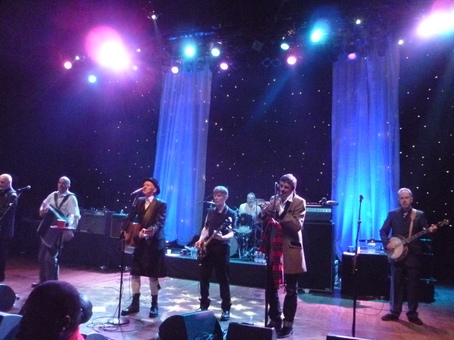
 
The playing-up-to-his-image thing is fine, but what surprises me is MacGowan is determined to make the songs sound good and is less concern with getting so smashed, that he sacrifice’s the ability to perform. It’s a big step for the man in my eyes, but maybe a let down for some here who perhaps were looking forward to a good first-hand Shane MacGowan crash and burn story, like what happened in the old days of the band. They’ve all learned a few lessons no doubt, but The Pogues still put on the best rabble at an age where many ‘former-greats’ are cranking out piss-weak covers album or flogging Time Life CD compilations on TV. The sight of a greying accordionist performing a stage-length knee-slide and a banjo being thrashed in the fashion of electric guitar still somehow suits this band of merry makers. It’s as though through playing Celtic-punk, they earn a golden pass to act anyway they please at whatever age. Besides, the encore consisting of Sally MacLennane, Rainy Night In Soho and Fiesta might well be one of the finest ever seen at Festival hall.


lEIGh5


FESTIVAL HALL SETLIST: 04/04/2012

Streams Of Whiskey
If I Should Fall From Grace With God
Broad Majestic Shannon
Greenland Whale Fisheries
A Pair Of Brown Eyes
Tuesday Morning
Kitty
Sunny Side Of The Street
Repeal of the Licensing Laws
The Band Played Waltzing Matilda
The Body Of An American
The Boys From County Hell
Thousands Are Sailing
Dirty Old Town
Bottle Of Smoke
Sickbed of Cuchulain
encore:
Sally MacLennane
A Rainy Night In Soho
The Irish Rover
Poor Paddy On The Railway
Fiesta


Saturday, March 3, 2012

New Order: live in Melbourne, 2012 (review)

Venue: Festival Hall
Date: 01/03/2012


Increasingly desperate shouts of “C’mon!” punctuates each chorus of Love Will Tear Us Apart, as New Order reach the end of their first Australian concert in 11 years. Front man, Bernard Sumner wants us to show him exactly how much we love the song and how much we’ve missed his band. His enthusiastic cry is stunning and muscular, as it may well be. After all, Joy Division’s swan song will forever be a significant marker in New Order’s career. But their set tonight is nothing but continual proof of how much the band achieved subsequently, and is presented as a chance for them to share every mile stone – beautifully framed and hung - with their unwavering supporters.


The framing in this case is the fascinating visual projections accompanying each song. Film producer Michael Shamberg and graphic artist Peter Saville gave New Order’s music a very specific identity and here these songs and images combine to transport us to the heart of the Hacienda dance floor, sometime in the mid-1980s. The band manage the near impossible and deftly shift the atmosphere in Festival Hall like some alien race adapting its environment after a hostile take over. Resistance is not an option worth entertaining either. “Sorry about the weather…” Sumner apologises at one point, ”it feels a lot like home tonight.” As the words leave his mouth, vintage video footage of the band playing an early show in the actual Hacienda suddenly fill the screen, and they launch into a “never played live before” Here To Stay. The film, 24 Hour Party People told the whole story of the Hacienda’s importance to the Manchester scene; but the venue had significance enough for New Order to be immortalized in song. New Order’s true celebration of their past begins at this point - albeit in reverse order - but then there are also those bits of their past they’d rather soon forget.

 
In all the pre-tour media, as expected the focus was on matters of new band members (bassist Tom Chapman and guitarist Phil Cunningham) and the absence of Peter Hook. Its hardly the elephant in the room, but Sumner addresses it all the same tonight, “Oh look, we’ve got a new base player... How about that?” We cheer and welcome the slightly altered line-up, and if any Hooky die-hards are here tonight, they’re keeping pretty quiet. Chapman (Hook’s stand-in) chugs through the set with all the precision and fat riffs the songs were built on, smashing any worries that ‘it wouldn’t be the same without him’. There are plenty more standard New Order-isms in place to distract from the absent Hook and his famous low-slung bass stance anyway. A recently returned Gillian Gilbert is frozen behind her keyboard, serenely jabbing out those renowned melodies in apparent deep concentration; the very picture of familiarity. Sumner is bopping his head, eyes closed as he sings into a mic held delicately by one hand; as all images of him in concert will support. These details, along with a distinctly retro light show bring so much warmth on this wet, drizzly night.


The set is packed with carefully chosen ‘signature hits’ from start to finish, but the strong start – Elegia, Crystal, Regret – sees only sporadic pockets of dancing from the cross-generational crowd. It’s True Faith at the midway point that finally brings the crowd to full, pulsing life, while Bizarre Love Triangle starts the closest thing to a mosh pit seen all night. It’s during this track I notice members of System Of A Down watching motionless from the side of the stage, casually chewing bubble gum, perhaps even harbouring a little envy after their own lackluster Soundwave sideshow show the night before. New Order, despite being a much older band, never sound tired or careless with the material. Sumner’s never been the most powerful vocalist, but following a fantastic 1963, he gives himself a mental pat on the back for striking ever note. “That was the best one so far tonight, I think.” He grins. The audience might argue that point though – Temptation as with True Faith is a clear favourite, still sounding incredibly fresh at 31 years-old, although it takes a good minute to become familiar. Many of the older tracks have been sharpened up, extended and even remixed with the help of some sweet advances in live electronic music re-creation, but the focus never really drifts too far from the ‘live band’ sound.


They are going to close with you-know-what, but after a brief exodus, New Order return to the stage in silhouette for an encore which is still loaded with expectations. Blue Monday’s juddering beats begin from out of nowhere. The stage is in darkness except for an animated orb roving around the drop screen, and on cue, the audience clap in time. Sumner finally emerges to join the others, just as his vocal part is scheduled to begin and blue light saturates every corner of the hall. For the moment I’m all goose-bumps, and believe me it’s not cold in here. Blue Monday’s in-concert life actually began in Australia on the band’s 1983 tour where it was first ‘road tested’. I can’t help thinking its debut was a huge hit with local crowds even back then, otherwise would we even be chanting its haiku-like verses three decade later? Thanks to things such as setlist.fm, we knew there was no second encore coming, so the final applause seemed unfittingly brief.


Having grown up knowing New Order’s later material first, I was still left with the feeling that this was as authentic an experience of a ‘classic New Order show’ as anyone could want. Maybe they’re a few kilos heavier, and they’ve tidied up their sound and lost a member or two, but nothing about this concert spelled desperate last stab at relevance. If anything, the celebration of their musical history was indicative of a bright future at a stage in their career where there is no certainty at all beyond this tour. Here’s hoping the show was as good for them as it was for us and it isn’t long before we get to party with New Order like its 1989 all over again.


lEIGh5

 
FESTIVAL HALL SET-LIST:


Elegia
Crystal
Regret
Ceremony
Age Of Consent
Here To Stay
Krafty
1963
Bizarre Love Triangle
True Faith
5-8-6
The Perfect Kiss
Temptation
encore:
Blue Monday
Love Will Tear Us Apart

Thursday, February 23, 2012

Gillian Gilbert (New Order) interview: 2012

RE-NEWED ENERGY


Gillian Gilbert is at the Macclesfield country home she shares with husband/New Order drummer, Stephen Morris when I phone. She immediately slips into a relaxed chatty mode, happy to discuss New Order’s past, present and future – after all, it’s been a long time since any typical band activities – rehearsals, touring, international press, New Order itself, have encroached on the keyboardist’s life. The 32nd inconsistent year of the iconic band’s existence is upon us, and Gillian, as with each member at some point or other, is a little surprised to be back. “You just never know with us what to expect, really.” She understates. However, New Order’s latest reunion is a very different story to previous times. The silence that followed the band’s last album - 2005’s Waiting For The Siren’s Call - was broken by a statement in 2007 - apparently from within the group’s ranks – that New Order were ‘no more, and never likely to be again’.


New Order, 1980
That announcement made by (now ex) bassist Peter Hook was, it turned out, a false indicator as he was the only one at that particular meeting. Hook’s subsequent plundering of Joy Division’s back catalogue and threats of legal action against the remainder of New Order (for using the name without his involvement) are now matters for the public to cast opinion on, but New Order’s surprise return in late 2011 - excluding Hook - implies a solidarity within the group still exists and is willed to power in the roughest of times. But then their name did always suggest purposeful leadership, with an even vaguely hierarchical connotation, which all seemed very cocky considering they essentially began in 1980 as 'Joy Division minus the popular singer'. As New Order, they chose a new lead singer basically on the flip of a coin, and for a time nobody in their right mind would have bet on a future for the band. Perhaps though, it’s that ‘unlikely rise’ from potential post-Ian Curtis obscurity that formed the catalyst for New Order’s ‘survive anything’ mentality. Few bands after all have endured their level of disharmony from outside and within their own ranks, so it’s not such a surprise, that in the wake of a very public battle with Hook, their passion has again beaten their hate.


Bernard Sumner, Gillian Gilbert and Steven Morris re-united as New Order last year with a new bassist Tom Chapman and second guitarist Phil Cunningham. On the eve of their first Australian visit with the new line-up - and with no new album to promote – Gillian surely speaks for the whole band when she says that this reunion was a more ‘tentative one’ than previous times. “We didn’t really know how it (touring a new line-up) was going be received by the New Order fans, or if the interest would even still be there. But we have come to think of this time as like a new beginning, really.” The first New Order show without Hook was intended as a one-off benefit gig for long-time friend of New Order’s, Michael Shamberg – a film producer responsible for the bulk of New Order’s stylish and surreal music videos - who became terminally ill. It was also the first show to feature Gillian back behind the keyboard following her indefinite departure in 2000 to look after her sick daughter, “I missed just being with everybody.” She recalls, “It took me a long time to get used to not being in New Order.” The line-up was completed by members of Sumner’s other band, Bad Lieutenant but the obvious Hook-shaped hole in the band raised potential problems for the long term.


Performing Blue Monday on TOTP, '83.
“We were quite scared about doing a fully fledged tour with new band members, because we had to of course work out if Tom could cope with such a big part to play.” Gillian offers, “So instead of barging back into the spotlight as it were, and announcing some big ‘come-back‘ tour, we took small steps.” Tom Chapman will inevitably be compared to Hook at every show on the tour but, Gillian notes, it’s wrong to assume he’s merely imitating. “Tom isn’t copying Hooky, he has his own style of playing. Tom wasn’t there when we recorded those songs, and so it stands to reason that he hears them differently to Hooky and has his own take on them.” New member’s aside, the current New Order live show reflects on the band’s past now more than ever, and the visual identity created around New Order’s music. Gilbert explains, “In the past it was always about touring to promote a new album or whatever, but preparing for Michael Shamberg’s benefit concert, forced us to listen to a lot of our older material – some of which we haven’t played live since the ‘80s – and create a set list to go along with a lot of the videos he produced.” Those videos, including Blue Monday’s oddly posed dogs, Bizarre Love Triangle’s falling suited men and True Faith’s mime artists gone feral are images as iconic as the songs themselves, Gillian agrees.


                                                  the classic 'True Faith' video


“I’ve always loved what Michael did with True Faith especially.” The video, which features costumed dancers performing increasingly violent, synchronised routines, thinly hides the band’s most overt drug-referencing in a song.  True Faith – the song and video - was one of the first to drag underground club culture into the mainstream, where it was immediately deemed ‘unsavory’. “I remember Radio One refused to play it unless we changed some of the words.” The original lyric “Now that we’ve grown up together/they’re all taking drugs with me” was tamed down to “Now that we’ve grown up together/they’re afraid of what they see”. “It was never about promoting, or glamorising anything though,” Gillian adds, “Meanwhile, nearly every song on the radio now it seems, is loaded with drug references, only it doesn’t seem to be an issue anymore. Is it shock for the sake of shock value? Yes, I think so.” And if any band should know, it’s New Order. 


Keyboardist Gilbert, also

occasionally played guitar in NO.


Madchester, Baggy, Acid House, and a slew of other music/drug-related sub-cultures have all been credited to New Order’s influence on music, but a scene was already in the making, born from a rapid rise in street-level music creation and a potentially destructive new wave of party drugs. New Order simply provided the best possible soundtrack for whether you were going out, or coming down. The scene bloomed within the well documented home of Tony Wilson’s Factory label and Hacienda nightclub, but many of the bands and many more of the drugs ultimately proved bigger than either business. New Order survived Factory, but only just. To recoup some of their lost earnings, the band reconvened in 1990, “for what we thought would be one last time”, to record the official World Cup anthem – World In Motion. In a bittersweet twist, the song hit number one at the same time New Order were broke, disbanded and had little hope of a future. “It was encouraging having a number one single, yeah, but really we did that record as a commercial venture because we were in trouble financially.” Gillian confirms, “Steven (Morris) had the idea to do it, and just because we knew it would be used by all the TV stations broadcasting the World Cup, we all agreed. It was one of the few financially smart things we did as a band.” Its romantic to think the band keep New Order going for ‘love not money’, and although Hooky is the current bug in the band’s ointment, their instability had begun long ago as a result of bad business. It’s often downplayed for the sake of a good mud-slinging story, but Factory crashed during the making of New Order’s then come-back album, 1993’s Republic which ended the band’s tolerance for the industry for many years. Regarding the band's future plans however, Gillian can only offer her personal wishes.


“I would like to finish this tour, take a short break and then see what the future brings. We don’t have plans beyond these shows right now, but that can be an exciting prospect as well." She ads, "I don't think we will be recording a full album again, but I'd like to do an E.P. perhaps. We always had singles that weren't on albums in the past, so I think an E.P. would be a good compromise of those two things." As for the recent history in which ties between New Order's and Hook have seemingly been cut for good, Gillian concludes, "Many things way out of our control have slowed us down over the years, but… I think, in a way, the band is bigger than us as individuals, which makes it easier to carry on in the face of… whatever the universe can throw at us. I think with this group getting back together, we knew there would be battles (Hook) to get through, but in New Order, that’s just how we play."


lEIGh5


The 'Low Life' album and tour was unusual in that it was the one and only time the band's images were used in the promotional artwork.


Tuesday, February 7, 2012

Noel Gallagher's High Flying Birds: live in Melbourne, 2012 (review)

Venue: The Palais
Date: 31/01


Re-emerging only last year with a new band - The High Flying Birds - and whole new set of songs, the elder of OasisGallagher brothers, Noel set himself the unenviable task of starting from scratch. Although most of the songs on the High Flying Birds’ album were written in 2008 while Noel was still in Oasis, his writing more than hinted at a severing of old ties. 2011 single, the no-hold’s barred The Death Of You And Me, heralded Noel’s new life as a solo artist, and showed a promising, more purposeful direction than most latter day Oasis. Of the new tracks, which are spread equally throughout ‘the classics’ tonight at his Melbourne Big Day Out sideshow, none can be written off as mere ‘Oasis-lite’ rehashing. Still, expectations for Noel’s solo gig were pretty moderate for me I confess.


Would the shadow of Oasis hang heavily over proceedings, as a half-full arena of disgruntled fans just mark time until Wonderwall? Well as it turns out, not even close. Gallagher is the very picture of the fabled phoenix from the ashes of his old band. Standing before us drenched in red and blue lights, age defiant was a possibly even more cocky Noel than the one who once celebrated a life of ‘cigarette’s and alcohol’. Tonight, he confidently reminds all who had forgotten how brilliant a performer he actually is, and how many bloody good songs he’s written. In place of the geezer trying to relive the glory days I half expected, was a master showman proving you can’t beat experience - fuck knows, nothing has beaten Noel Gallagher.


Following a standing ovation on his arrival, Gallagher kicks off with (It’s Good) To Be Free, and the choice is a master stroke. This old b-side, which has surely taken on new meaning for Gallagher in recent times, gains an immediate reaction from the packed in crowd who seem determined to match Gallagher and his band in volume. Its all the warm up he and his audience need too, as the show’s momentum and crowd response continue to elevate – especially once Gallagher wonders aloud ‘why is everyone sitting down?’ As we all gladly surrender our comfort, the band delivers a run of six tracks from High Flying Birds’ debut, each a triumph of thrilling, edge-of-your-seat rock. If High Flying Birds remind me of Oasis at all, then it’s the best elements of serendipitous sophomore (What’s The Story) Morning Glory and bust-up album, Dig Out Your Soul, which tellingly was recorded at the same time High Flying Birds was taking shape. If I Had A Gun ranks closest to ‘the Oasis sound’, offering a peak into what might have been, and also a ‘last look back’ moment before the brand new as-yet-unreleased, Freaky Teeth.


Midway through, and the electric guitar makes way for an acoustic and Noel’s band depart, leaving only him and keyboardist, Mike Rowe. Tuning up, Noel reads the crowd for a moment and gets a cheer. “Who was Saint Kilda?” He yells, while strumming something familiar. “It’s not in the Bible – I’ve checked.” Out of the laughter, a fan offers; “She was a prostitute!” Noel scoffs in return, “You’re a fucking prostitute, mate.” The laughter soon turns to cheers as Whatever (I’m Free) is suddenly upon us, along with the customary sing-a-long. The already up mood inside the Palais plateaus and Noel draws the moment out with a stunning, stripped back rendition of Supersonic - Oasis’s debut single which although has been ‘re-imagined’ still holds its power as one of the most fun songs Gallagher ever wrote.


We then welcome the rest of the band back on stage for the 'most fun' song High Flying Birds have in their cannon – (I Wanna Live In A Dream In My) Record Machine. Noel’s all about momentum tonight, he’s brought his audience up and is determined to keep us there. The second set seems to fly by, as each carefully chosen song forms a kind of ‘greatest hits’ package. New gems such as Soldier Boys and Jesus Freaks meld into unsung classics, Half A World Away and Talk Tonight. The many ex-pat Brits in the audience, hoarse from belting out the words along with Noel, near topple over each other in a bid to shower praise on the man as the triple banger encore comes around. Little By Little, The Importance of Being Idle and closer, Don’t Look Back In Anger made their homes long ago in the hearts of Brit-pop fans at closing time sing-a-longs and blurry-eyed cab rides home. Tonight, Gallagher’s fans share with their idol the fondness each and every one of them hold for these songs. Noel knows to not even bother singing on Don’t Look Back In Anger – the entire audience unite in a roof-raising effort all their own – and Gallagher’s uncharacteristic grin speaks volumes in its own right, as he enjoys a momentous end to a show by one of the classiest come-back's in recent times. Nice one, 'our kid'.


lEIGh5


THE PALAIS SET-LIST, 31/01/2012


(It's Good) To Be Free
Mucky Fingers
Everybody's On The Run
Dream On
If I Had A Gun
The Good Rebel
The Death Of You And Me
Freaky Teeth

Whatever (I'm Free)


Supersonic
(I Wanna Live In A Dream In My) Record Machine
What A Life!
Talk Tonight
Soldier Boys and Jesus Freaks
Broken Arrow
Half The World Away
The Wrong Beach
encore:
Little By Little
The Importance of Being Idle
Don't Look Back In Anger


Thursday, October 6, 2011

Joanne Catherall (The Human League) interview: 2011

SUPREME BEINGS


In what could've been seen as a bid to off-set the synthetic-foundations of their music, the ‘human’ side to the Human League was always overtly the central focus. The spotlight was on three radically styled and made-up vocalists - Phil Oakey, Susan Anne Sulley and Joanne Catherall – each presenting a strong individuality, yet functioning smoothly as unit, delivering warm, yet exclusively machine-made tunes. In the early days of electronic music, the embryonic Human League (Mk I - before Catherall and Sulley), were among a handful of groups who saw potential in dragging synths out of the underground clubs and into the mainstream. Once they shook-off a few computer programmers posing as musicians - and a Kraftwerk obsession  found on first two albums, Reproduction and Travelogue - a band emerged that would set the blue-print for a whole new direction in music.  In 1981, following a smart line-up change which remains to this day, The ‘League Mk II’ was born and it is they who are celebrating the 30th anniversary of the ‘new romantic’ movement’s first ever break-through record, Dare! - an album fashioned on the hope that ‘this synth-pop thing was gonna take off’.


Everyone either had or wanted a synthesizer in 1981 - or so it seemed - but it’s interesting to note now that this must-have addition to any band was treated with great suspicion by established artists in fear of redundancy. It was the marker of the times, forcing many acts who’d trail-blazed in the 1970s into an ‘adapt or die’ situation, which saw many four-piece rock acts suddenly scramble to work a bit of ‘new wave’ into their sound. Meanwhile artists like New Order, Vince Clarke, and Thomas Dolby were fast taking over as the ‘new innovators’, as their mastery of the synth gradually helped earn it acceptance. The Human League however, were young enough that this new synthetic sound was a mere formality and rather than make a ‘press-play-and-go’ programmable keyboard their main feature, it was simply the engine under their swanky hood, upon which leapt a wave of image-conscious front and centre singers, all reaching for the lippy and hairspray, while busting out robotic dance moves.


Ahead of Human League’s Australian visit for the ‘80s Rewind Festival, speaking with me today in defense of the humble synth - and dodgy robot-dancing - vocalist Joanne Catherall from her home in Sheffield begins by recalling the massive influence of, Dare!, and how her band had to fight to release the record that would ultimately define the new romantic movement.


“Our first record deal was for ten albums, which is just unheard of today, but the catch was, we were told in no uncertain terms, we could not make Dare! the way we wanted to.” Catherall says, “But we decided we had nothing to lose really by ignoring them (Virgin), I mean none of us owned a house or any of that, and so broke as we were, we went ahead and made the record that we had in our heads and it obviously became very successful. But we made Dare! almost in direct opposition to what the label wanted us to do. They wanted us to get in a full live band, but Phillip (Oakey) was only interested in using synthesisers, as that was how the first two Human League albums (Reproduction, Travelogue) were made, but the group was changing, myself and Susan (Ann Sulley) had joined, and I think the label thought we might as well get a guitarist and drummer too… Phil wasn’t having any of it, though.”


In what sounds like a quaint notion by today’s standards, The Human League was singled out at the start of the 1980s as reluctant poster stars for a campaign called ‘Keep It Live’. Using synthesisers was viewed by the media old guard as ‘cheating’ and some sectors of press launched attacks on the burgeoning new romantic scene, claiming the bands shouldn’t be seen as ‘performing live’ in the traditional sense. “It is quaint to think of that now, as you say when you have tours by artists like Britney Spears who, it is claimed, do not even sing live.” Joanne continues, “The dancing has become so elaborate that it must be impossible for them to sing and perform, which is why you always saw me and Susan just doing our sort of robot routine,” she laughs, “It was the only way we could sing live and dance at the same time!” Making their own mark within The Human League was important for Joanne and Susan, so as not to be seen as just ‘backing dancers who sang a bit’. So after fronting up as co-lead vocalists on Dare! single, The Sound Of The Crowd – which became the band’s first chart hit – Joanne’s confidence bloomed. 


“I was genuinely thrilled that people reacted so strongly to that song, I mean, it’s very unusual in a lot of ways, and honestly Susan and I didn’t think it was going to be a hit at all, but our careers really did take off because of that song.” In Australia, The Human League enjoyed a level success on the back of Dare!, only rivaled by the UK. The band’s first tour in 1982, Susan remembers, was ‘akin to Beatle-mania’. “There were hoards of fans at the airport with banners when we arrived, and camping in the hotel’s reception area. I mean, we couldn’t even leave our hotel rooms without being mobbed.” She giggles, “It was like ABBA: The Movie!, and I can tell you, we hadn’t had that kind of reaction anywhere else in the world, so Australia will always be a bit special to us for that reason.” The Human League were in Australia just two years ago promoting a new album, Credo, yet their current billing on the ‘80s Rewind Festival places them squarely in the ‘coming out of retirement’ sector. Never in the past has Joanne been comfortable with the retro tag, but she is content to claim her band are nothing if not survivors. 


“The thing about the three of us, is that we’re all too stubborn to just give up on The Human League. Never have we sat down and all said ‘let’s just call it a day’, you know, and we got a lot of strength by proving how wrong the people were who wrote us off as a ‘80s flash-in-the-pan act.” Surviving has also meant remaining close with her ex-partner, Phil Oakey - whom Joanne was romantically involved with for most of the 1980s - and enduring periods of declining interest. However, these days the trio are tighter than ever, and it seems, are rarely out of each other’s pockets. “We go away on tour so much together that even now there’s never more than two weeks in the year where we don’t see one another.” Joanne says. “But we couldn’t have stayed together as a band for 30 years if we didn’t get on though, and our secret to success has always been knowing our roles in the band and not stepping outside of those. I mean I would never go into the studio and start telling Phillip how to use the synthesiser – I wouldn’t know one end of it from the other – and Susan and I aren’t involved in the songwriting either, but we take care of the business of running the band, which means that we see each other pretty regularly when not on tour as well.”


The business side of things goes from typical band activities, to Joanne’s appointed role as Human League’s accountant. It became apparent that to get through the tough times, minding the band’s economy, as with all other aspects themselves, was essential. “We were burnt a few times financially, and there were some very trying years personally.” Joanne adds, “Our label went bust the day our 2001 album Secrets came out, and we obviously very depressed about it, but instead of walking away, we decided to tour extensively and reconnect with our fans, and it was tough at first, but it kept us going and we have hardly stopped since then, I’m happy to say.”


lEIGh5


Tuesday, August 23, 2011

Clouds, The Wonderstuff, Jesus Jones: live in Melbourne 2011 (review)

Venue: The Palace

Date: 19/08/2011


“Did that really just happen?” I say to myself in the moments following Jesus Jones’ final exit from the Palace stage, after an encore that concluded a night 20-plus years in waiting. This triple bill of bands that all peaked quite some time ago, could only truly tickle the fancy of a very specific age group – children of the early 1990’s – and it is precisely those ‘children’ who’ve flocked to the Palace tonight to rejoice in and lament the last ever pre-internet era in music, known as the early ‘90s.


Jesus Jones in particular were a major part of my education, as I slipped from top 40 radio into this new wow thing called ‘alternative music’. Remember that? Looking back, Jesus Jones were the perfect vehicle to carry a newbie into lower-end-of-charts comparative weirdness. At the time, they represented everything that had been missing from the music I had known, but suddenly found myself needing. Meanwhile closer to home, Sydney’s Clouds had blipped on the radar around the same time, with their strange but sing-a-long tunes and a reputation as the must-see live band. I didn’t see them, but as first band up tonight Clouds, who hadn’t played together since 1997, deliver an eerily powerful and dust-free set, safely securing that reputation. However, time wouldn’t allow them a sound-check for this show, and as a result there is something slightly mechanical about watching them perform some of their most-loved tracks. Soul Eater, 4pm, Immorta, Say It and Bower Of Bliss are undoubtedly superior to the recorded versions, but the band’s rigid presence suggested they were anxious to just get through the set – as marvelous as it is – and leave. They end on a meticulously rendered Hieronymus, playing as though every fragment of the song was burned into their collective brains, and leave us hanging with no encore.


Perhaps not all that many were here for Clouds tonight, and they picked up that they weren’t playing to ‘their crowd’ as such, but no doubt the vibes are still good all round as most people are just here to enjoy three fine examples of a great period in music. Although it’s a seemingly unrelated line-up of acts - a Jesus Jones fan is basically indistinguishable from a Wonderstuff fan, at least until the many British-accented punters present chime-in following Clouds' set. One ex-pat speaks hazily into my ear between bands of how important it was to ‘choose your tribe’ during the British post new-wave in the early ‘90s. Jesus Jones, EMF and Age Of Chance fans would never have been seen at a Wonderstuff gig back in the day, for those bands were worshipped by a totally different clan and mixing was off the table. This tribalism however looks to be long-gone, as no Pulp Mis-Shapes-style’ war on the dance floor takes place and it’s thankfully still too cold for the Balmy Army to make an appearance. Further evidence of tribalism’s death needed? The Wonderstuff have only gone and got ex-Pop Will Eat Itself drummer Fuzz Townshend to bash the bins for them, and their placing on tonight’s bill could be read as ‘Jesus Jones’ opening act.’


But whoever decided on the running order of the bands was probably tossing a three sided coin. Jesus Jones had top billing, but exactly why so is not obvious by any traditional ‘biggest seller’ means… Until Wonderstuff take to the stage and things became a little clearer. Performance wise, Wonderstuff are incredible. They deliver a riot of, mainly drinking songs that would make Shane MacGowan proud, and all the energy of an out-of-control Red Bull delivery truck. However, the spectacle of singer Miles Hunt at 47 years of age in Play School presenter’s regalia – stripy t-shirt and ill-fitting denim overalls - and the mysterious return of his circa-1991 bushy mane (heads it’s a wig….) probably seemed like a good idea on paper, but I found the music more enjoyable when I wasn’t actually watching him. Presentation wise, they would have been far more suited to headlining a fancy dress barn dance is all I’m saying.


Some part of me really wanted Jesus Jones to emerge in their (now) vintage skate gear, and still sporting enormous fringes, but perhaps fearing a Wonderstuff-esque pantomime, they opted for smart casuals. Besides their new dressed-down look, vampish lead singer, Mike Edwards hasn’t aged in any obvious way whatsoever, but rather seems to be transitioning into a dandy-ish fop. With not an ounce of fat on Edward’s body and barely a wrinkle on his chiseled face, somewhere out there, Jarvis was seething. The rest of the almost-all-original line-up (they have a new drummer) resemble archetypal aging ravers with a bit of a nod to heavy metal thrown in for good measure. Basically Jesus Jones look exactly like they sounded at their peak, and just as both bands before them tonight, deliver a set pooled only from their first three albums – or the ‘hit period’ - Liquidizer, Doubt and Perverse. It’s been 20 years since the Jones boys have played in Australia, and with tongue slightly in cheek, Edwards declares, “We’ll just do a few songs you used to know.” They kick off with Doubt’s Who, Where, Why? – a song of lost identity which could not be more fitting for the band now. Jesus Jones self-confidence early on verged on arrogance. Mike Edwards fully believed his band were making ‘the music of the future’, but in saying so, he placed his band’s heads neatly onto the block and the brutal lashing he received from the press resulted in rapidly dwindling interest/product post 1993 album, Perverse.


Perhaps Jesus Jones weren’t so wide of the mark though. The Prodigy proved the masses were open to the idea of a slightly daft electro-metal act, but alas, if only Jesus Jones hadn’t thought so hard about it all. At least for a time, they were music’s baggy jeaned fortune tellers. Sounding very fortuitous now, 1991’s anti-pop hit single, Real Real Real blasts forth its claim that pop music is on a downward spiral into ‘safe and samey’ terrain. It might not have rung Nostradamus’s bell, but at least someone was saying it. Nostalgia concerts are strange things when the band in question once stood firm against ‘repeating the past’ but its undeniable that Jesus Jones would not be touring at all were it not for a single piece of music - 1991’s Right Here Right Now - and its impact beyond the charts. Politicians campaigned with it playing in the background, advertisers sought its power to push their products and street demonstrations rang with its message of instant revolution. It’s also the song that a large number of fans tonight were happy to leave once hearing. Mike waves goodbye from the stage as the exodus occurs leaving the hard-cores with some very welcome extra dance-floor space. 


The rest of the set is a fan’s dream list of b-sides, near-forgotten album tracks and even one new song, which was promising to say the least, but it’s their debut single, Info Freako that gets the warmest welcome. A cry of ‘FINALLY!’ rings out from one punter at the barrier, who had been waiting possibly years for Perverse stand-out track Idiot Stare, and further voices are raised in response to the ‘song we haven’t played live in 20 years’ – Blissed - another from Doubt. All up, Jesus Jones play a well-considered set, but by the time their one-song encore is over, there’s two gaping holes in the shape of The Right Decision and Devil. Incredibly, they chose the far less interesting Zeros & Ones as major representative of their dense electro-metal phase (Perverse) which was certainly not the right decision. Still, the concert felt way too short despite the band covering so much ground, which translated means, it was a fucking brilliant ride to be on, and knowing that every song played was one closer to the end of an unlikely to ever be repeated event, was enough to cause minor welling up in these eyes.


lEIGh5


JESUS JONES - PALACE SET-LIST: 19/08/2011

WHO, WHERE, WHY?


MOVE MOUNTAINS


INTERNATIONAL BRIGHT YOUNG THING

CARICATURE

REAL, REAL, REAL

NOTHING TO HOLD ME

GET A GOOD THING

NEVER ENOUGH

ALL THE ANSWERS

MESSAGE

RIGHT HERE, RIGHT NOW

ZEROS & ONES

BRING IT ON DOWN

INFO FREAKO

IDIOT STARE

BLISSED


Sunday, July 31, 2011

Wild Beasts: live in Melbourne 2011 (review)

Venue: Corner Hotel

Date: 28/07/11


Good news, music lovers! The lost link between XTC, Friendly Fires and Crying Light-era Antony and The Johnsons has finally been found… about bloody time, you might say. Wild Beasts - as it is they - bring together the power of a stadium rock show, and the intimacy and heart of a folk festival, which although sounds atrocious in print, the Leeds based neo-psychedelic rock/soul act, saw to it tonight at the Corner, that fans were unanimous in their agreement – the combination somehow works.


The very, very indie, mostly male crowd found themselves robbed of a whole two hour’s composure, on this second visit by Wild Beasts to our shores, as part of the amazing Splendour 2011 line-up. On record, these guys impressively strain and simper over rolling percussion and strings, favouring unstructured spacing - as is the will of bands in the post-Sigur Ros world – only much like Mariah Carey’s urge to use every fucking note on the octave scale - just because she can - Wild Beasts perhaps could do with reining in a bit that ‘desire to dazzle’ so much on stage as they are quite clearly gifted musicians, and have a solid cannon of songs working in their favour. 


To give an example of just how well versed and ‘in control’ they were in setting up the right vibes, the band managed to drink enough alcohol between them to dull the pain of three Christmas’s, and although they were, “still really, really jet lagged”, as co-lead singer Tom Fleming states, nobody dropped a single musical baton in their multi-multi-instrumental set-up. These guys are switching instruments in every direction tonight, and taking to it like it ain’t no thang. But hey, if any one of the four guy/one girl team were slackin’ off – guitarist Ben Little did spend a considerable amount of time on the floor - drummer Chris Talbot proved a sensational distraction for them to catch a break. Holding a steady gaze throughout, Talbot played his enormous kit – which included a timpani – as though he were leading a charge into battle.


Despite the drummers commanding presence however, it was all eyes on Wild Beasts’ remarkable lead vocalist, Hayden Thorpe and his roof-raising falsetto. A lot was made of the fact that Brett Anderson (of Suede) and Jeff Buckley sang in falsetto because ‘it just wasn’t done’ in the days of flannelette-shirted rawk, otherwise known as the ‘90s, and I wonder if it’s because of those two artists that more and more male singers are finding their inner eunuch now? Or is it all down to Justin Hawkins from The Darkness? Probably. But whatever the cause, Thorpe is a magnificent on the ‘shrinking balls’ choral vocalising, but not as high pitched live as on the band’s three albums, surprisingly. But Thorpe, as unique as his voice is, has found a wonderous foil in co-lead singer, Fleming. The duo, who are positioned either side of back-to-back keyboards, never outshine, but virtually match one another note for note, and it hits me that I never knew it was two guys I was hearing all along on those tracks.


Of the band’s back catalogue, their set is a pretty generous serve of second album, Two Dancers, which clearly pleases the crowd, who get rowdiest during We Still Have The Taste Dancing On Our Tongues and Hootin’ & Howlin’. Although the stand-out performances were of The Devil’s Crayon and Brave Bulging Buoyant Clairvoyants from their debut release, Limbo Panto by far. To these most festive of Wild Beasts’ songs, a core group of fans gather on the smaller side stage to dance. “Hey I love the Top Of The Pops thing you guys have got going on over there!” Thorpe cracks, only to be met with confused expressions from the ‘too young’ invaders.


Maybe it was a little harsh to say the band over do the ‘dazzle’ in a clear desire to go against typical indie band clonery, but on reflection, their show would simply have worked better in a stonking big arena. In other words, Wild Beasts were a jet engine blasting in a two-car garage in this setting, and their performance was far from ‘considerate of the neighbours.’ If my prediction’s anywhere near right, we were lucky to see them in such an intimate venue tonight because somebody soon is gonna see what these Beasts are capable of if let out to play, in which case it’ll be ‘watch your arses, Muse’.


lEIGh5


CORNER HOTEL SET-LIST:


Play Thing

Loop The Loop


Deeper

The Devil's Crayon

We've Still Got The Taste Dancing On Our Tongues

Albatross

Invisible

This Is Our Lot

Bed Of Nails

Hooting and Howling

Reach A Bit Further

Lion's Share

Brave Bulging Bouyant Clairvoyants

All The Kings Men

End Comes Too Soon


Sunday, June 12, 2011

Lou Rhodes (Lamb) interview: 2011

FRIENDLY WITH FIVE


Manchester duo, Lamb were written off by just about everyone – including themselves – come the middle of the last decade. Following a short-lived peek into world-wide success at the end of the ‘90s, vocalist Lou Rhodes and musician Andy Barlow, began to fall out of love with the music once it became a pressure game of commerce and repetition. However, a core of devoted fans had the foresight to not give up on the pair and this year, their devotion has finally paid off – although at a price. Lamb, embracing a little numerology, not to mention some grass roots marketing, announced their long awaited fifth album, 5, funded entirely by fan pre-orders. It may seem a long way from the runaway success of 1997 single Gorecki, but as Lou Rhodes points out, with fans like theirs, who needs labels?


“The scary bit was selling something that we hadn’t even made, so you’re asking for quite a leap of faith from people, you know.” Rhodes begins. “But then, I think it’s a great basis for a creative endeavor. That desire to make something that we felt truly proud of was stronger than ever." Lou explains, “We were making an album for the first time ever with absolutely no funding from some nervous corporation looking for big hits, as was our experience in the past, which definitely had an effect on the music.” After what began as a four-date tour in early 2010, which then grew into months of advance bookings, Lamb were approached to do a short Australian tour in February his year. It was at these shows that for the first time in seven years, their set included brand new music.


“When we were asked to do those shows in Australia, we panicked a bit because we hadn’t even finished the record, but actually it turned out to be a good opportunity to see how well the new tracks worked along side our older stuff. We ended up premiering only four new songs, but that really was the acid test we needed to say what was working and what needed to change.” She continues, “The songs do metamorphose whenever you play them live, so it was important to let the new ones begin their journey of tweak and change.” Rhodes laughs gently. “The process of playing new songs live is like a game of Chinese whispers. You have a blueprint, and you think you know what the outcome will be, but little surprises always emerge in the actual telling.” She adds, “I’d really like to do that a lot more, because the problem with being in the studio, is you usually finish an album and then go on tour and that’s when this kind of growth happens within the songs, but by then it’s too late.” Already 5’s mini road test has Rhodes rethinking the band’s future performances.


“In the past we had always kept in mind what we were going to play live and how, and it was never more than half the record, but with 5, we found that we couldn’t decide what not to play. At this stage we’re doing eight out of the ten songs and we’d like to work in the other two at some point because it works so well in its complete form.” Rhodes adds that she has always struggled with the concept albums judged only by the singles – no doubt a concern that has sprung from personal experience. Lamb’s mammoth hit, Gorecki from their self-titled debut, although rewarding the band with obscene levels of exposure, also bought with it ‘unreasonable expectations’. While recording their second album, Fear Of Fours, the inevitable pressure of matching that song’s success was applied to the duo by their label, causing Rhodes to remark following their split in 2004, Lamb had long felt restricted by what was expected of them. “It was always tough for me to see Lamb as a singles band, because I don’t really listen to very much commercial music or even claim to know how to make ‘hit singles’ on command.” Lou retorts. “In the old days we had to endure conversations that went like, ‘can you sound a bit more like Bis, because they’re selling a lot of records at the moment’, which was quite soul destroying for us.” Lamb released three more albums over the next seven years before acrimoniously splitting. It wasn’t until Lou Rhodes was recording her third solo album One Good Thing in 2009 that she and Andy’s reunion occurred. “I was looking for somebody to produce my album and Andy just said, why not him!” At their rather organic reunion, creative sparks soon began to fly and Lamb’s future was decided on – only with a few clear changes to be made.


“When we decided we were going to make another record, Andy and I had a very honest conversation about what Lamb should and should not be about.” Rhodes explains, “I felt that I had compromised quite a lot on some of our albums and we kind of lost something along the way, but this time we agreed to keep it raw and just gently add to the songs as they needed, like we did on our first record. Also it was really important for us to not overproduce this album. I mean all up it only took five months to make which was very, very quick for Lamb.” Rhodes’ words are suggestive of somebody running from their past mistakes, but Lamb were always spared the often harsh criticisms of the UK press usually reserved for non three-chord rock bands. One doesn’t have to dig very far to then to see Lamb are in fact their own strongest critics, and although many band’s have long lulls following initial peaks, few return with their shit so fully together as they have. Lou reflects on what the refreshed Lamb we hear on 5 was bringing to the come-back party, and some of what was quite cheerfully thrown out.


“I’m a great believer in your first idea is probably your best before the ego kicks in and says oh but why not add this and add that, but simplicity was definitely the key in this case.” She points out, “Also I think for me as a vocalist, too many times on previous albums, my voice had been extremely processed, or rather I was affecting it in certain ways, feeling that I needed to be something that I wasn’t. But having that time off and doing my acoustic albums gave me a chance to let my voice grow and I allowed myself to get comfortable again as a singer.” Rhodes naturally understates her sensational talent as a singer, but evidenced particularly by the tracks She Walks and Wise Enough, is an artist shaking off self-doubt and indulging her love of singing. Lamb’s new-found confidence doesn’t end there, either. Album closer, Existential Itch is a brilliantly executed reminder that in today’s self-absorbed world, we can easily forget that the human experience is a shared one. Lou divulges,


“That song kind of sums up a lot of the record and going through this period of questioning everything I had once believed in. Not just with music, but life in general which I think most of us go through at some point.” She adds, “With the title, I thought existential crisis seemed too strong a word because what I was going through seemed quite natural in a way. I think the word crisis carries the wrong implication, or at least I didn’t see it as a crisis personally, I recognised that it was a much needed time of learning.”


lEIGh5


Ah, the gorgeous Lou and Andy... You know, I never made the Little Britain connection until I transcribed the interview... !!


EPK on Lamb recording their beautiful new album, "5".